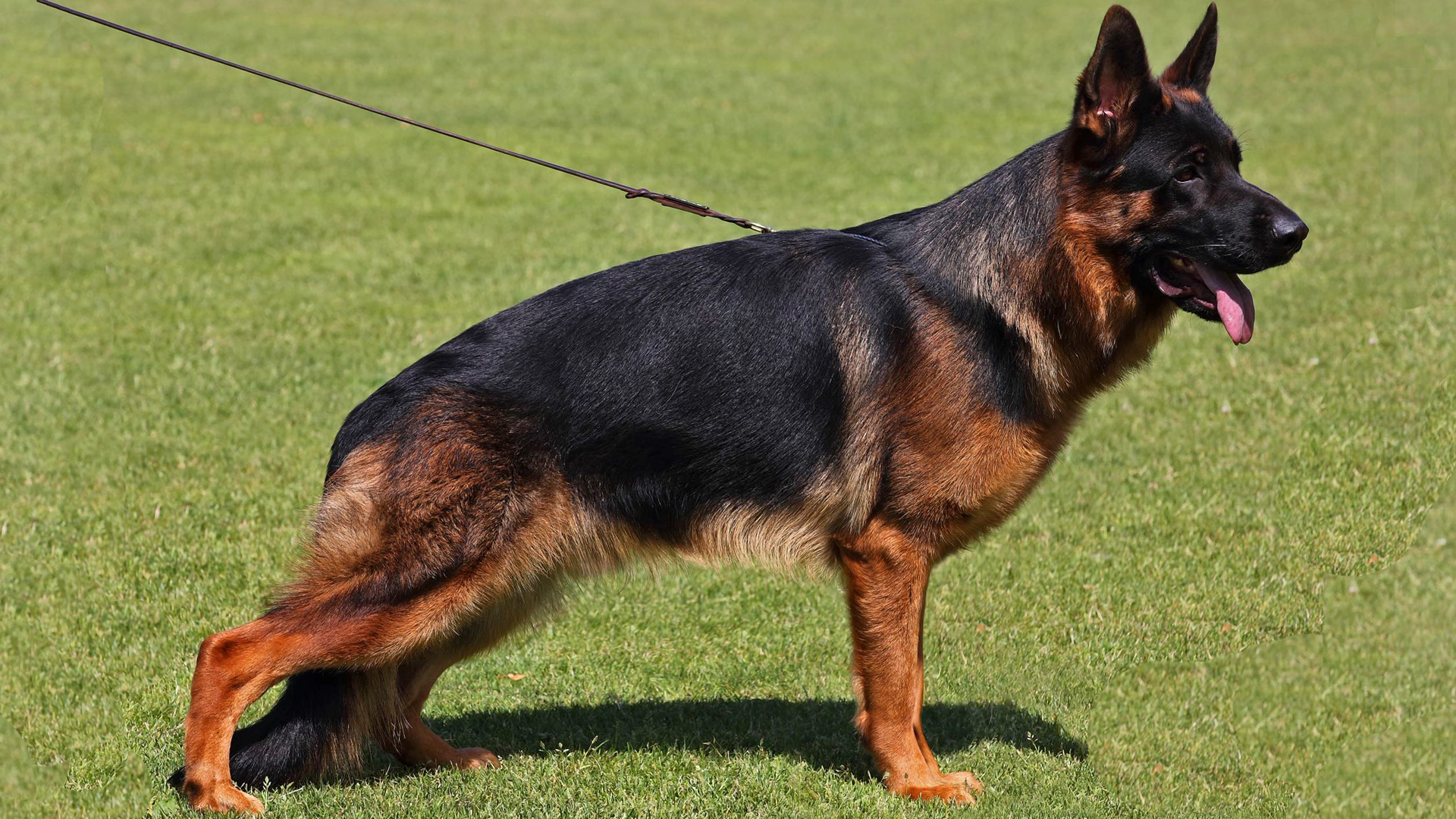
What Is Stacking in the German Shepherd Dog?
Stacking is the deliberate, gentle positioning of a German Shepherd into a classic show stance. It is not a trick or a gimmick — it is a structured way to see what the dog really is: its topline, withers, angulation, proportions, and overall harmony as a working breed.
What Stacking Looks Like
In a correct stack, the German Shepherd stands with the front legs straight and well under the body, the neck carried proudly, and the head alert. One hind leg is placed slightly forward and the other slightly back, creating a natural triangle. This lets experienced breeders and judges clearly see:
- The strength and firmness of the topline (back and loin).
- The height, length, and correctness of the withers.
- Front and rear angulation and their relationship to each other.
- Proportions, balance, and overall breed type.
When the dog is not stacked or “in pose,” they look like a normal German Shepherd — standing or moving naturally, just like any other companion dog. But for high-end breeding programs using world-class German bloodlines, the stacked position is essential. It reveals strengths and weaknesses that are not always visible when the dog is relaxed or in casual motion.
Why the Withers and Topline Matter
In a correct German Shepherd, the withers are high and pronounced and are a key part of the dog’s topline. The pose is specifically designed to emphasize the desired conformation, including the relationship between the withers, back, and hindquarters. From this position, world-level breeders can evaluate:
- Withers: height, length, and smooth transition into the back.
- Back and loin: strength, firmness, and correct (not soft, not roached) structure.
- Croup and hindquarters: length, position, and how they support powerful, efficient gait.
Stacking, Movement, and Working Ability
Stacking is not just about a “pretty picture.” It connects directly to the dog’s ability to move correctly and work for long periods. A well-structured, well-stacked German Shepherd should show:
- A clean, flowing topline that stays strong at the trot.
- Balanced front and rear angulation that translates into efficient, ground-covering movement.
- Correct weight distribution over the feet for stability and endurance.
This is why stacking is used together with movement and working tests (including IGP1, IGP2, IGP3 performance and Körung (Kkl1) breed survey) in serious SV/FCI breeding programs.
Temperament and Nerve Strength in the Stack
A correct stack also reveals temperament and nerve soundness. A confident, clear-headed German Shepherd will accept handling and hold the pose calmly, even in a busy environment with other dogs, people, and noise. This shows:
- Stable nerves: the dog does not panic or shut down.
- Handler responsiveness: the dog cooperates willingly, without fear or resistance.
- True confidence: the dog remains balanced and clear in the head.
In Körung (Kkl1) and high-level shows, judges are not only looking at structure — they are also reading courage, stability, and overall character. A dog that looks beautiful but cannot handle the pressure is not considered a complete German Shepherd.
Puppies vs. Adult Stacking
Stacking is used for both puppies and adults, but expectations are different:
- Puppies: stacking puppies is gentle and brief. The goal is not perfection, but to see early clues of structure, proportions, and temperament. It helps breeders predict future potential in a litter.
- Young adults and adults: stacking is more refined. The dog is asked to hold the pose longer so judges can carefully assess every detail of the breed standard.
Is Stacking Uncomfortable or Harmful?
When done correctly by an experienced handler, stacking is not harmful and should never be rough or forced. The dog is gently guided into position, and the pose is held only briefly. Signs of correct handling include:
- The dog remains relaxed, breathing normally, and engaged with the handler.
- No yanking, no hard lifting, and no extreme over-stretching of the joints.
- The dog steps into the pose willingly, often with minimal correction.
If a stack looks extreme or uncomfortable in a photo, it is often just a frozen moment in motion, a poor camera angle, or an inexperienced handler. In professional programs, the dog’s welfare and long-term soundness come first.
Why Serious Breeders Rely on Stacking
For breeders like Gunbil German Shepherds, stacking is a crucial tool for deciding which dogs truly represent the exemplary standard of the German Shepherd breed. The stacked pose offers a precise, honest view that you simply cannot get from casual photos or natural standing positions alone.
Stacking helps identify:
- Exceptional dogs that should be carried forward in a breeding program.
- Structural weaknesses that need to be corrected with careful pairing.
- Which puppies may be better suited for show, sport, or family companion homes.
Whether you see stacking in show rings, Körung evaluations, or professional photo sessions, remember: the pose is not about “posing for social media.” It is about protecting the integrity, health, and long-term quality of the German Shepherd Dog.
Questions About Stacking or Structure?
If you have questions about how stacking relates to structure, working ability, or breeding quality, we are happy to help. Our program focuses on world-class German bloodlines, sound temperament, and correct conformation — the complete German Shepherd.
We can help you understand what you are looking at in a stacked photo, how to compare dogs fairly, and what truly matters for a healthy, confident family companion or future working dog.
- Guidance on evaluating stacked photos and videos.
- Support in choosing the right puppy for your goals.
FAQ — Stacking (Poise) in the German Shepherd Dog
What is stacking (poise)?
Stacking is the classic show stance where a German Shepherd is gently placed in a specific posture so breeders and judges can clearly evaluate structure, balance, and topline. It is a tool used in serious German programs (SV/FCI) to compare dogs fairly and honestly.
Does stacking hurt my dog?
No — when performed correctly, stacking is not painful or harmful. The dog is guided into position with calm, confident handling, and the pose is held only briefly. A well-bred German Shepherd with sound structure and temperament should accept the stack without stress.
Why does the back sometimes look sloped in stacked photos?
The German Shepherd is designed as a working, trotting breed with a firm, slightly sloping topline that supports efficient movement. In a correct stack, the withers are pronounced, the back is strong, and the croup and hindquarters are positioned to show how the dog will drive from behind. Poor angles, over-stretching, or incorrect handling can exaggerate this appearance and do not represent proper structure.
How does stacking relate to IGP and Körung (Kkl1)?
In serious German breeding, structure and working ability belong together. Dogs are evaluated not only by their stacked conformation, but also by their performance in IGP1, IGP2, and IGP3 and their Körung (Kkl1) breed survey. Stacking gives a clear picture of structure; IGP and Körung show courage, stability, and working character. Together, they define a complete German Shepherd.
Why do top breeders share stacked photos of their dogs?
Stacked photos are a transparent way to show structure, proportions, and topline. For families and other breeders, these photos provide much more information than casual snapshots. They help demonstrate why a particular dog or litter is considered world-class quality and worthy of inclusion in a serious breeding program.